
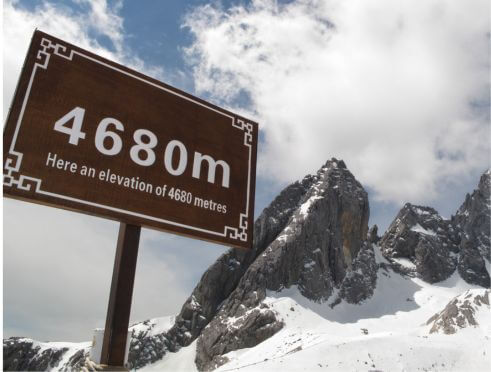
Dolpo Altitude Sickness: Symptoms, Prevention & Safe Trekking Tips
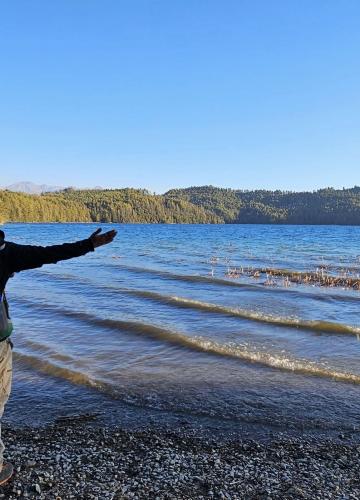
Dolpo's landscapes look magical. The turquoise waters of Shey Phoksundo Lake, the ancient Bon monasteries, and the raw silence of Upper Dolpo valleys. It's the kind of place that makes you feel like you've stepped into another world.
The thin air at high altitude doesn't care how fit you are. It doesn't care how many mountains you've trekked before. One moment you're soaking in those incredible views, and the next you're dealing with a pounding headache, nausea, or you can barely breathe properly. Dolpo altitude sickness is real, and it catches more trekkers off guard than you'd think.
The good news? It's largely preventable. You just need to know what to expect, how to spot warning signs early, and what to do if things go sideways. This guide covers everything: symptoms, prevention, acclimatization strategy, and emergency preparedness.
Dolpo Altitude Sickness Quick Summary
- Dolpo altitude sickness usually starts above 3,000 meters because oxygen levels drop significantly at high elevations.
- The most common form is acute mountain sickness (AMS), which causes headache, nausea, fatigue, dizziness, and loss of appetite.
- Serious altitude illnesses include High Altitude Pulmonary Edema (HAPE) and High Altitude Cerebral Edema (HACE), both of which can become life-threatening without immediate descent.
- Upper Dolpo has a much higher AMS risk because trekkers spend multiple days above 4,000-5,000 m.
- Major high-risk areas include Dho Tarap, Saldang, Kang La Pass, and Jeng La Pass.
- The best prevention methods are slow ascent, proper acclimatization, hydration, rest days, and avoiding alcohol.
- Diamox can help reduce AMS symptoms, but it does not completely prevent altitude sickness.
- Helicopter evacuation is available in Dolpo, but rescue can be delayed due to bad weather and remote terrain.
- Spring (March-May) and Autumn (September-November) are the safest seasons for reducing altitude sickness risk in Dolpo.
What Is Dolpo Altitude Sickness?
Dolpo altitude sickness is a health condition caused by low oxygen levels at high altitudes, usually above 3,000 meters during trekking in the Dolpo region of Nepal. It happens when the body cannot adjust properly to thinner air and reduced oxygen.
The most common form is Acute Mountain Sickness (AMS). It usually shows up as headaches, fatigue, nausea, or dizziness. Mild AMS symptoms are common among trekkers at high altitude, especially during rapid ascent.
But there are two far more serious conditions you need to know about:
- High Altitude Pulmonary Edema (HAPE): Fluid builds up in the lungs, making breathing extremely difficult
- High Altitude Cerebral Edema (HACE): Fluid builds up in the brain, causing confusion, loss of coordination, and in severe cases, coma
These aren't common, but they happen. And when they do, especially somewhere as remote as Dolpo, the stakes are incredibly high. The key is catching symptoms early and not pushing through them. That's really the whole game.
Why Altitude Sickness Is So Common in Dolpo
Altitude sickness is common in Dolpo because trekkers gain elevation rapidly in an extremely remote, high-altitude region with limited medical access. Factors like fast ascent, high passes above 5,000m, dry climate, and long trekking days make AMS risk significantly higher here than on most other Nepal treks.
Dolpo isn't your average trekking destination. It's one of the most remote regions in Nepal, possibly in all of the Himalayas. And that remoteness creates a set of risk factors that stack up fast.
- The elevation gain happens quickly. You fly into Juphal (around 2,475 m), and within a few days, you're pushing past 3,500 m, 4,000 m, and beyond.
- High passes demand big climbs. Kang La Pass sits at around 5,360m. Jeng La Pass is up there too. These aren't optional side trips, they're the trail itself.
- Medical facilities are basically non-existent. In Dolpo, you're on your own. The nearest proper medical help could be hours away by helicopter, and that's only if the weather cooperates.
- Dehydration sneaks up on you. The dry, cold air in Dolpo pulls moisture out of your body faster than you'd expect. Most trekkers aren't drinking anywhere near enough water, which makes AMS symptoms worse.
- Long trekking days. When you're covering big distances with significant altitude gain every day, your body never really gets a chance to catch up.
Basically Dolpo is remote, high, dry, and demanding. That combination makes altitude sickness genuinely risky here in a way it isn't on shorter, lower, or more accessible treks. This is why proper preparation for high-altitude trekking in Dolpo is extremely important before starting the journey.
Planning your Upper Dolpo adventure? Visit Dolpo Caravan Treks to explore safe Dolpo trekking itineraries, expert-guided journeys, and professionally planned high-altitude treks across Nepal.
Dolpo Trek Altitude Profile Explained
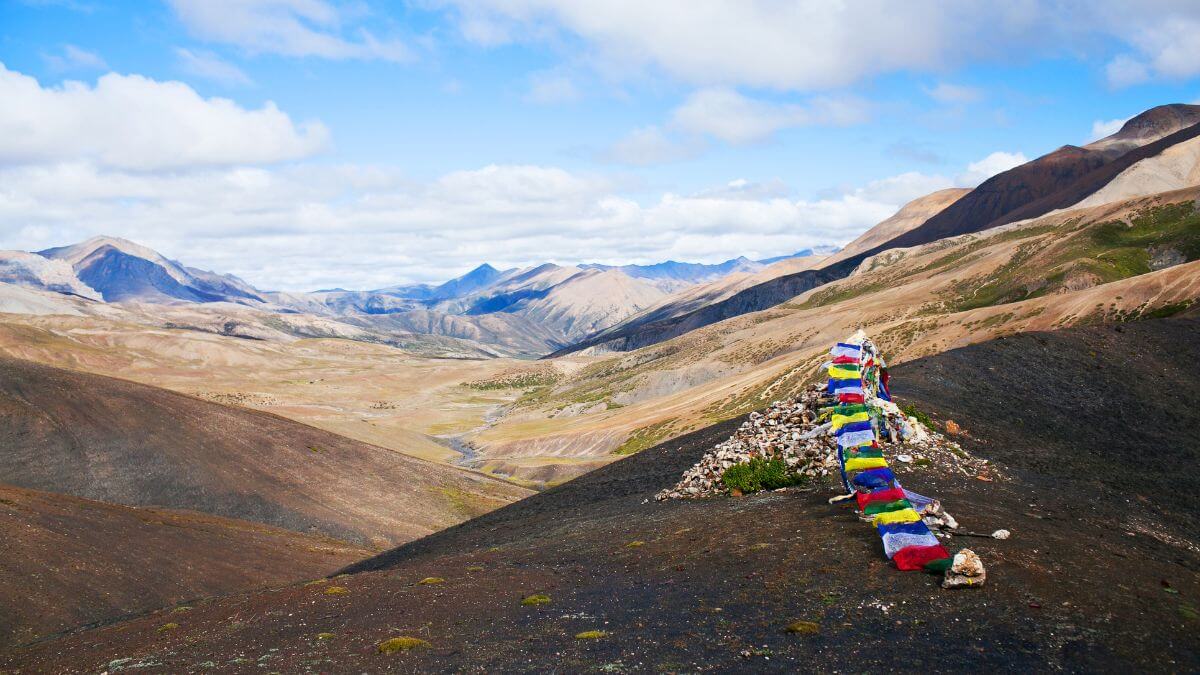
The Dolpo trek starts at Juphal (2,475 m) and climbs to passes above 5,000 m. Elevation gains are steep and fast, giving your body very little time to adjust between key stops. Checking an Upper Dolpo trek map beforehand helps trekkers understand elevation gain and difficult pass crossings
Starting Point: Juphal Altitude
Most Dolpo treks begin with a flight into Juphal at roughly 2,475m. It's manageable, but the real issue is what comes next. The trail climbs steadily through Dunai and up to Shey Phoksundo Lake (3,611 m), inside Shey Phoksundo National Park, and that's still Lower Dolpo. Upper Dolpo goes much higher.
One key rule to remember: sleeping altitude matters more than hiking altitude. Hike to 4,500 m during the day but sleep at 3,800m, your body recovers overnight, not during the climb.
High-Risk Areas During the Trek
There are many high-risk areas during the trek that include:
- Dho Tarap (~3,944m): A major stop in Upper Dolpo, beautiful but high enough that AMS symptoms commonly appear here
- Saldang (~3,700m): Another key village, remote and cold
- Kang La Pass (~5,360m): This is where things get serious. Crossing this pass is a major physical challenge
- Jeng La Pass: similar elevation range, similar risks
Dangerous Elevation Zones Above 3,500m
Once you cross 3,500m, your body is working noticeably harder. Oxygen levels at 5,000m are roughly half of what they are at sea level. Half. Your body has to produce more red blood cells, breathe more deeply, and push harder just to do basic things.
Trekkers who come from sea level feel this the most. Even those who've been at moderate altitude for a while can struggle when the terrain jumps sharply.
Common Dolpo Trek AMS Symptoms
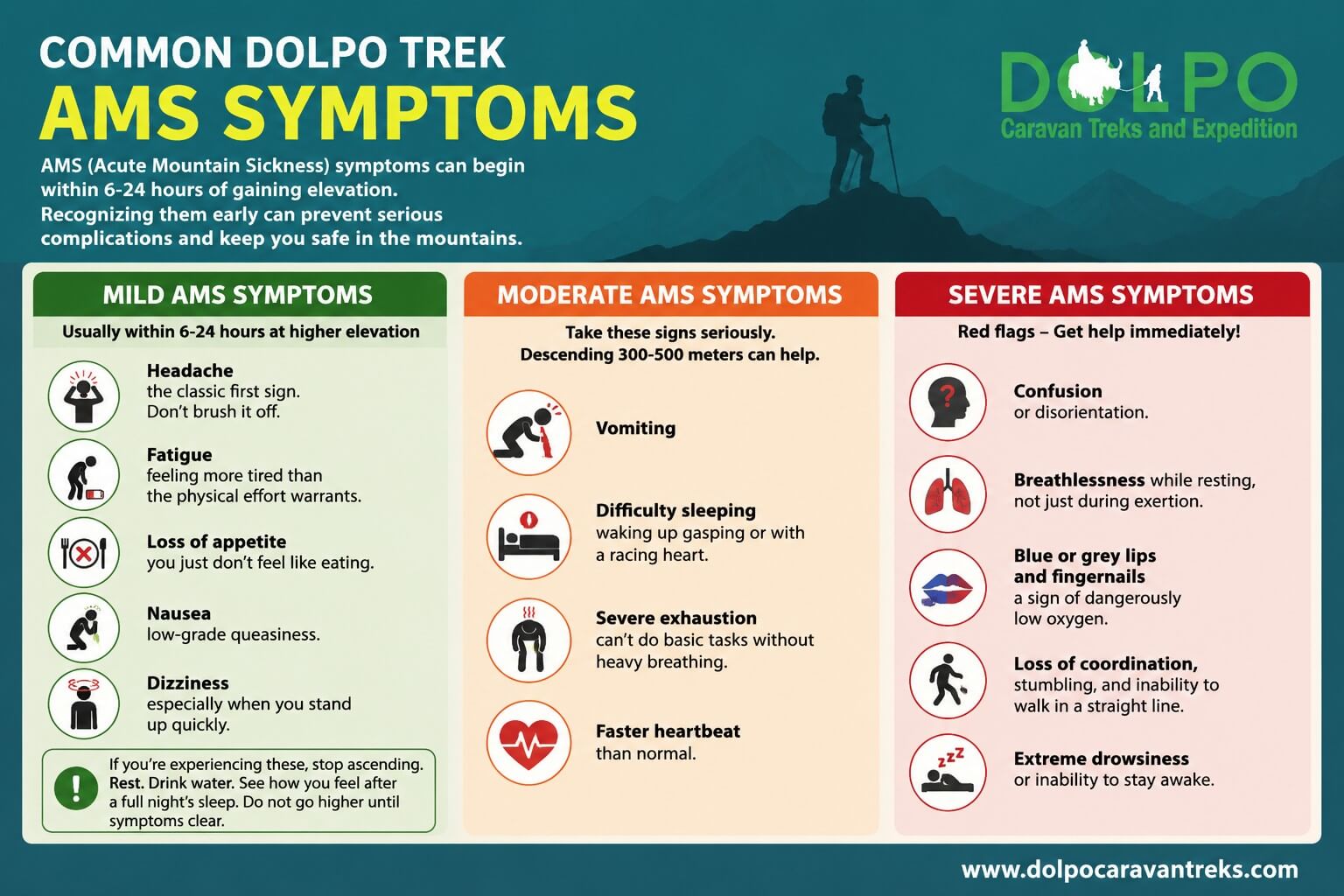
AMS symptoms in Dolpo typically begin within 6-24 hours of gaining elevation and range from mild headaches and fatigue to severe breathlessness and confusion. Recognizing them early is the difference between a simple rest day and an emergency evacuation. Many trekkers underestimate how physically demanding and difficult the Upper Dolpo trek can become at higher elevations.
Mild AMS Symptoms
These usually appear within 6-24 hours of reaching a higher elevation:
- Headache: the classic first sign. Don't brush it off.
- Fatigue: feeling more tired than the physical effort warrants
- Loss of appetite: you just don't feel like eating
- Nausea: low-grade queasiness
- Dizziness: especially when you stand up quickly
If you're experiencing these, stop ascending. Rest. Drink water. See how you feel after a full night's sleep. Do not go higher until symptoms clear.
Moderate Symptoms
- Vomiting
- Difficulty sleeping (waking up gasping or with a racing heart)
- Severe exhaustion: can't do basic tasks without heavy breathing
- Faster heartbeat than normal
At this point, you need to take this seriously. Descending 300-500 meters often makes a dramatic difference.
Severe Symptoms That Need Immediate Help
These are the red flags:
- Confusion or disorientation
- Breathlessness while resting, not just during exertion
- Blue or grey lips and fingernails (a sign of dangerously low oxygen)
- Loss of coordination, stumbling, and inability to walk in a straight line
- Extreme drowsiness or inability to stay awake
Understanding HAPE and HACE in the Dolpo Region
HAPE and HACE are the two most life-threatening altitude conditions trekkers can face in Dolpo. Both develop fast, and both require immediate descent, and in Dolpo's remote terrain, waiting too long is not an option.
What Is High Altitude Pulmonary Edema (HAPE)?
HAPE is fluid buildup in the lungs. It's one of the leading causes of altitude-related deaths in mountain trekkers worldwide. What makes it especially dangerous is that it can develop fast, sometimes within 24 hours.
Signs of HAPE include extreme breathlessness (even at rest), a persistent wet cough that may produce pink or frothy mucus, crackling sounds when breathing, and severe weakness. If oxygen levels on your pulse oximeter are dropping fast and breathing is getting harder, that's HAPE territory.
Treatment requires emergency descent and oxygen support.
What Is High Altitude Cerebral Edema (HACE)?
HACE is swelling of the brain caused by fluid accumulation at high altitudes. It's rarer than HAPE but equally deadly if not caught in time.
Signs include severe headache that doesn't respond to ibuprofen, confusion, hallucinations, loss of balance, and eventual loss of consciousness. The "tandem gait test," walking heel-to-toe in a straight line, is a quick way to check. If someone can't do it, that's a serious warning sign. HACE requires emergency evacuation.
How to Prevent Altitude Sickness in Dolpo
The best way to prevent altitude sickness in Dolpo is to ascend slowly, stay hydrated, eat well, and take rest days seriously. Learning the important things to know before trekking Dolpo can reduce many avoidable altitude-related problems. Preparation and discipline matter far more than fitness level alone.
- Drink water: Aim for 3-4 liters per day at altitude. Dehydration makes AMS significantly worse.
- Eat enough food: High-carbohydrate meals are better at altitude. Your body burns more calories in the cold and at elevation. Loss of appetite is common, but try to eat anyway.
- Sleep at lower elevations whenever possible: Climb high during the day and sleep lower at night. This is the single most effective acclimatization strategy.
- Go slow: Most trekkers move too fast. You're not racing. Every extra hour you take going up a steep section gives your body more time to adapt.
- Consider Diamox (acetazolamide): This prescription medication speeds up the acclimatization process by making you breathe faster. It doesn't eliminate AMS risk completely, but it helps a lot.
- Skip the alcohol: Especially in the first few days at altitude. Alcohol dehydrates you and suppresses your breathing while you sleep. It's basically a recipe for altitude sickness.
- Rest days are non-negotiable: Don't treat them as optional. One rest day every 3-4 days of climbing is a minimum. Your body needs time to produce more red blood cells. Good trekking preparation before arriving in Dolpo makes acclimatization much easier.
Best Acclimatization Strategy for Upper Dolpo Trek
The best acclimatization strategy for Upper Dolpo Trek is to gain no more than 300-500m of sleeping elevation per day, take rest days every 1,000m gained, and stop at key villages like Dho Tarap and Saldang before tackling higher passes.
Why Acclimatization Matters
When you go to high altitude, your body starts a series of changes: you breathe faster, your heart rate increases, and over days and weeks, you produce more red blood cells to carry oxygen more efficiently. This process is called acclimatization. You can't rush it. You can only support it.
Upper Dolpo altitude sickness risk is higher than Lower Dolpo simply because the elevations are greater, the passes are more demanding, and the trek is longer. Your body needs more time.
Recommended Daily Altitude Gain
The golden rule: above 3,000m, don't increase your sleeping elevation by more than 300-500 meters per day. Take a full rest day for every 1,000m of altitude gained.
So if you slept at 3,500m last night, aim to sleep no higher than 3,800-4,000m tonight. And plan rest days into your itinerary, not as backup, but as essential parts of the plan.
Best Places for Acclimatization Stops
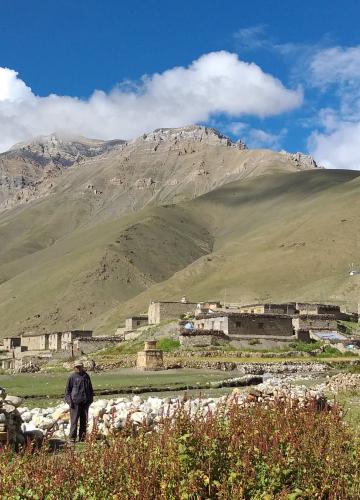
Dho Tarap is one of the best places to take an acclimatization rest day in Upper Dolpo. It's a real village, there's food and shelter, and it sits at an elevation that makes it a natural halfway point before the bigger climbs ahead.
Saldang is another solid option. Spending an extra day here before tackling higher terrain gives your body a meaningful chance to catch up.
Don't skip these stops just to save time. The cost of not acclimatizing properly is way higher than a day's delay.
Why Upper Dolpo Has Higher AMS Risk Than Lower Dolpo
Upper Dolpo carries significantly higher AMS risk than Lower Dolpo because you're spending multiple days above 4,000 m, crossing passes above 5,000 m, in extremely remote terrain with no easy bail-out options. Even the Lower Dolpo trek difficulty becomes challenging for trekkers who are not acclimatized properly.
Lower Dolpo Trek peaks at Shey Phoksundo Lake (3,611 m), and most trekkers adjust reasonably well with a slow approach. Upper Dolpo is a different story. You're spending multiple days above 4,000m, crossing passes above 5,000m, and doing it in extremely remote terrain with no bail-out options nearby. The combination of sustained high altitude, physical demand, and remoteness makes Upper Dolpo altitude sickness prevention a serious priority, not just a precaution.
What To Do If You Get Altitude Sickness in Dolpo
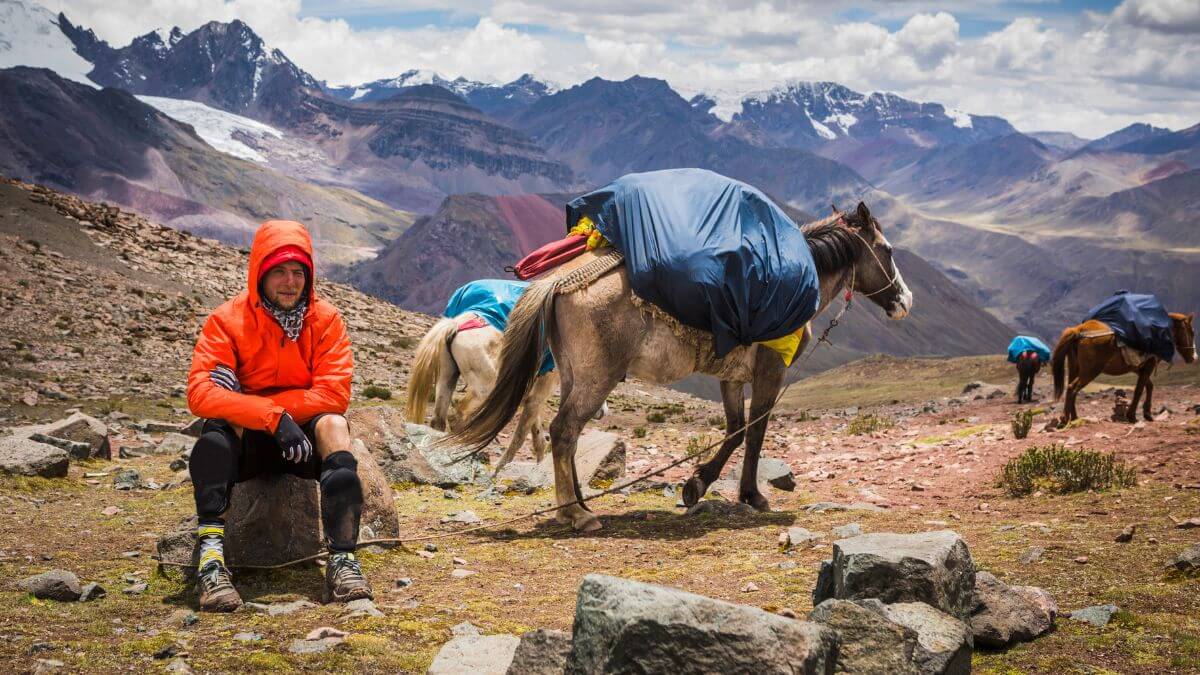
If you get altitude sickness in Dolpo, stop ascending immediately, rest, and descend if symptoms worsen. Acting fast is everything when medical help is hours away.
- Stop Ascending Immediately: Stop the moment you notice any AMS symptoms, even mild ones. Don't push further.
- Descend to Lower Altitude: Even 300-500 meters of descent make a significant difference, it's the most effective AMS treatment there is.
- Use Medication If Necessary: Diamox, ibuprofen, or supplemental oxygen can help, but they support descent, they don't replace it.
- Call for Helicopter Evacuation in Severe Cases: For HAPE, HACE, or rapidly worsening symptoms, call immediately. Make sure your insurance covers helicopter rescue above 5,000m. This is why trekking insurance with helicopter evacuation coverage is not optional for Dolpo. It's essential. Make sure your policy covers evacuations above 5,000 m.
Have questions about Dolpo altitude sickness, acclimatization, or trek safety? Contact our trekking experts for personalized advice, safer itinerary planning, and emergency preparation guidance before your trek.
Emergency & Rescue Preparation for Dolpo Trek
Emergency rescue in Dolpo is difficult because the region is extremely remote, weather conditions change quickly, and helicopter access is not always guaranteed. Proper travel insurance, emergency preparation, and early response to altitude sickness symptoms are essential for safe trekking in Dolpo.
Why Rescue Operations Are Difficult in Dolpo
Dolpo is genuinely remote. There are no roads. Communication is patchy at best. In bad weather, helicopters simply can't fly, and weather in the Himalayas can turn in hours.
If something serious happens in the middle of a multi-day section between villages, you could be looking at many hours, potentially a full day or more, before help arrives. That reality should shape how seriously you take prevention and preparation.
Why Helicopter Insurance Is Essential
A helicopter evacuation from Dolpo can cost anywhere from $3,000 to $10,000 USD or more. Without insurance, that bill falls entirely on you. With proper coverage, it's covered (as long as you've read the fine print and your policy covers the elevation).
Check that your insurance explicitly covers:
- High-altitude helicopter evacuation (above 5,000m)
- Medical treatment costs
- Rescue search and operations
When Emergency Evacuation Becomes Necessary
- Suspected HAPE or HACE
- Oxygen saturation dropping below 70-75% and not recovering
- Severe confusion or loss of consciousness
- Inability to walk or stand
- Any condition that's rapidly worsening despite descent
Emergency Items Every Trekker Should Carry
- Pulse oximeter: Cheap, lightweight, tells you your blood oxygen saturation. Essential.
- First aid kit: Basic wound care, blister treatment, medications
- Diamox and Dexamethasone: Prescribed and briefed by a doctor before the trek
- Water purification tablets: Dolpo's water sources aren't always safe
- GPS or satellite communication device: In remote Dolpo, this could be a lifesaver
Best Time to Trek Dolpo to Reduce AMS Risk
Spring (March-May) and Autumn (September-November) are the two best seasons to trek Upper Dolpo and Lower Dolpo if reducing AMS risk is a priority. These windows offer stable weather and manageable temperatures.
Spring Season (March to May)
Spring is one of the best times for Dolpo trekking safety. Weather is relatively stable, skies are clear, and temperatures are manageable. The gradual warmth also means better trail conditions. Plus, stable weather means helicopter access is more reliable if you need it.
Autumn Season (September to November)
Post-monsoon autumn is arguably the most popular season, and for good reason. The skies are crystal clear, the views are stunning, and the weather is predictably good. This is the window most experienced Himalayan trekkers aim for.
Why Monsoon and Winter Increase Risks
Monsoon (June-August) brings heavy rain, landslides, and unpredictable weather. Dolpo sits in a rain shadow, so it's drier than much of Nepal, but the approach routes can be brutal. More importantly, helicopter evacuation becomes much harder.
Winter (December-February) brings extreme cold and heavy snow on the passes. Some routes become completely impassable. If something goes wrong in winter, rescue options are severely limited.
If you have flexibility on timing, spring or autumn would be good.
Final Thoughts
Dolpo is one of the most extraordinary places on earth. The landscapes, the culture, the silence, there's nothing quite like it. But it's also one of the most physically demanding treks in Nepal, and altitude sickness is a real, serious risk that you can't just willpower your way through.
Altitude sickness in Dolpo is serious, but it should never stop you from experiencing one of Nepal’s most incredible trekking regions.
With proper acclimatization, smart planning, experienced guides, and the right safety mindset, most trekkers complete the journey safely and successfully. The goal is not just to reach the destination, it’s to enjoy the journey, return safely, and remember the experience for the rest of your life.
A safe trek starts with the right people beside you. Meet our experienced trekking team and learn how our local guides help trekkers manage acclimatization, altitude safety, and remote Himalayan trekking challenges with confidence.
FAQs
How common is altitude sickness in Dolpo?
Altitude sickness is quite common in Dolpo, especially above 3,500 meters. Many trekkers experience mild AMS symptoms such as headache, fatigue, nausea, or dizziness during a rapid ascent. The risk is much higher in Upper Dolpo because trekkers spend multiple days above 4,000-5,000 meters.
At what altitude does AMS start in Dolpo?
Acute Mountain Sickness (AMS) can begin as low as 2,500-3,000 meters, but symptoms are more common above 3,000-3,500 meters. Since most Dolpo treks gain elevation quickly after Juphal, trekkers may start noticing symptoms within the first few trekking days.
Is Upper Dolpo riskier than Lower Dolpo?
Yes, Upper Dolpo has a much higher altitude sickness risk than Lower Dolpo. Upper Dolpo includes multiple high passes above 5,000 meters, longer trekking days, and more remote terrain with limited rescue access.
Can beginners trek Dolpo safely?
Beginners can trek certain Dolpo routes safely if they are physically fit, acclimatize properly, trek slowly, and travel with experienced guides. However, Upper Dolpo is generally better suited for trekkers with prior high-altitude experience.
Does Diamox prevent altitude sickness completely?
No. Diamox helps the body acclimatize faster and may reduce AMS symptoms, but it does not completely prevent altitude sickness. Proper acclimatization, hydration, rest, and slow ascent are still essential.
How many acclimatization days are needed in Dolpo?
Most trekkers need at least 1-2 acclimatization days in Lower Dolpo and 2-3 rest days in Upper Dolpo. Important acclimatization stops often include Dho Tarap and Saldang before crossing higher passes.
What should I do if I feel dizzy during the trek?
Stop ascending immediately. Rest, drink water, and monitor your symptoms. If dizziness gets worse or is combined with headache, nausea, or breathlessness, descend 300-500 meters and seek medical help if necessary.
Is helicopter evacuation available in Dolpo?
Yes, helicopter evacuation is available in Dolpo, but weather conditions and remoteness can delay rescue operations. Trekkers should always carry insurance that covers high-altitude helicopter evacuation.
Can you get altitude sickness at Shey Phoksundo Lake?
Yes. Shey Phoksundo Lake sits at around 3,611 meters, which is high enough for AMS symptoms to occur, especially if trekkers ascend too quickly without proper acclimatization.
What oxygen level is dangerous during trekking?
An oxygen saturation (SpO₂) level below 80% at high altitude is considered dangerous, while levels below 70% may become a medical emergency. Trekkers should monitor oxygen levels regularly using a pulse oximeter during high-altitude trekking.

Leave Your Comment